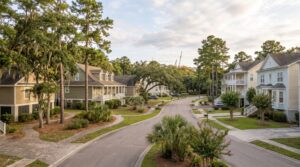

If there are really four separate housing markets right now, which one are you in, and how does that change your strategy in the Charleston Lowcountry?
The U.S. housing market has fractured into four distinct worlds: cash buyers, financed buyers, rate-locked homeowners, and builders. Each plays by different rules, and I see all four colliding daily across Charleston, Mount Pleasant, and Summerville.
Why This Matters Right Now in the Charleston Lowcountry
In late July 2026, Ryan Serhant, founder and CEO of SERHANT, went on CNBC’s *Fast Money* and said something I have been telling my own clients for months. He said the U.S. no longer has a single housing market. It has split into what he called “four Americas,” each driven by different economics because of elevated borrowing costs. Serhant specifically called out the Carolinas as a region attracting buyers who are looking outside traditional luxury markets for better value.
That observation maps perfectly onto what I see across my territory, from Summers Corner and Tea Farm in Summerville to The Peninsula in downtown Charleston to The Old Village in Mount Pleasant. Each of these neighborhoods tilts toward a different one of those four worlds. And if you do not understand which world you are operating in, you risk making decisions with the wrong playbook.
With 7 years of experience and over 107 closed transactions in this market, I can tell you that the biggest mistake I watch buyers and sellers make right now is treating the market as one thing. It is not. Let me walk you through all four.
America Number One: Cash Buyers in The Old Village and The Peninsula
If you are a cash buyer, you already know you have leverage. What you may not realize is how much that leverage has shifted as inventory has grown.
Cash transactions have represented a meaningful share of home sales nationally through early 2026. This group tends to be active across the price spectrum, from estate-level properties to investor acquisitions. In our market, that plays out clearly. The Old Village in Mount Pleasant, with its live oaks, pre-war cottages, and walkability to Pitt Street, has historically attracted cash buyers at the upper end. The Peninsula in downtown Charleston, where historic single homes south of Broad carry a premium for their character and location, is another pocket where I frequently see all-cash offers.
What does the growing inventory picture mean for you as a cash buyer here? According to the Charleston Trident Association of REALTORS MLS, active residential inventory across the entire MLS has reached approximately 5,800 to 5,900 homes on a three-month rolling basis as of October 2026. That is roughly four times the trough we saw in early 2022, when inventory bottomed near 1,300 to 1,400 listings, per the same CTAR MLS data. That expansion means you are no longer the only game in town the way you were in 2021 and 2022. Sellers have more options.
What I tell my cash-buyer clients is this: your advantage is speed and certainty, not a discount. In neighborhoods like The Old Village, where inventory can still be tight for the best properties, a clean cash offer with a short close still stands out. But you need sharper market intelligence now, not broader assumptions.
America Number Two: Financed Buyers Shopping Pre-Owned Homes in Mount Pleasant and Charleston
If you are buying with a mortgage in today’s market, the math is challenging, and I am not going to sugarcoat it. Rates have remained in the mid-to-upper six percent range through 2026. Serhant described this group as buyers paying about six and a half percent with 20 percent down, and that framing is accurate for most of the financed buyers I work with.
Here is the good news, though, and it is significant. That inventory expansion I just mentioned is working directly in your favor. With approximately 5,800 to 5,900 active listings across the CTAR MLS as of October 2026, you have more choices and more negotiating room than at any point since before the pandemic.
If you are looking at pre-owned homes in Mount Pleasant, near neighborhoods like The Old Village or the newer communities closer to the Isle of Palms connector, you are entering a market that has shifted toward balance. The same applies across much of the broader Charleston and Summerville resale landscape.
The mistake I watch financed buyers make is waiting for rates to drop to some magic number before they act. Meanwhile, inventory is the highest it has been in years. What you can do is buy with today’s inventory advantage, negotiate seller concessions toward a rate buydown, and refinance later if rates improve.
As someone rated 5.0 out of 5 stars by 33 past clients and recognized as a Realtor of Distinction, my approach is to help financed buyers model their real monthly cost, not just the sticker price. That is the honest conversation this group deserves.
America Number Three: Rate-Locked Homeowners Facing the Paralysis Decision
This one is personal for many of you. You bought or refinanced when rates were near historic lows. Your mortgage might be at 3 percent or below. And now your house does not fit your life anymore. Maybe the kids need more space. Maybe you are downsizing after retirement. Maybe a job brought you to the Lowcountry and you are renting while your old house sits there with a payment you cannot bear to give up.
A large share of homeowners nationally carry mortgages well below current market rates. Serhant described these homeowners as effectively trapped by their own low rates, and while that language is dramatic, the feeling is real for many people I talk to.
Let me give you a framework for thinking about this rather than just the fear. Consider a homeowner who bought at $400,000 with a 3 percent 30-year mortgage. Their principal and interest payment is roughly $1,686 per month. If they sell, take their equity, and buy a $500,000 home at 6.5 percent with 20 percent down, the new principal and interest jumps to roughly $2,528 per month. That is about $842 more each month. That is real money, and I never minimize it with my clients.
But here is what I also walk through with sellers in this position: your accumulated equity changes the picture. If you have significant equity, your loan amount on the new home may be smaller than you think. And if rates come down in the future, you can refinance, but you cannot get back the years spent in a home that no longer serves your family.
I see this play out across The Peninsula in downtown Charleston, where owners in historic homes may want a lower-maintenance lifestyle, and in Mount Pleasant, where families who bought smaller a few years ago now need more room. The CTAR MLS data showing inventory near multi-year highs means that if you do decide to sell, you are entering a more competitive listing environment. Pricing strategy matters more than it did in 2021. That is exactly where having an agent who specializes in this market makes a difference.
America Number Four: Builders and New Construction in Summers Corner and Tea Farm
This is one of my specialties, and it is the segment where the most creative deal-making is happening right now. Nationally, builders have been offering sales incentives, including mortgage rate buydowns, and that trend has been growing through 2026. Builders can buy down your mortgage rate, either temporarily through a structure like a 2-1 buydown or permanently, by contributing a percentage of the purchase price at closing.
In Summerville, communities like Summers Corner and Tea Farm are direct expressions of this dynamic. These master-planned neighborhoods are attracting first-time buyers and young families specifically because the effective interest rate, after builder incentives, can be meaningfully lower than what you would get on a resale home.
What I tell first-time buyers exploring new construction: read every term carefully. Some advertised rates are temporary or adjustable rather than fixed for the full loan term. A 2-1 buydown means your rate is reduced for the first two years but then adjusts to the full note rate. That is fine if you plan for it, but it is a shock if you do not. A permanent buydown, where the builder contributes enough to actually lower your fixed rate for 30 years, is a different and often stronger value.
As a new construction specialist with AgentOwned Realty Charleston Group, I walk my buyers through every line of the builder’s incentive structure. Builder incentives are not charity; they are marketing tools. Having your own representation ensures you understand what you are actually getting.
Serhant’s observation that the Carolinas are drawing buyers seeking value outside traditional luxury markets lines up exactly with what I see in Summerville’s growth corridors. Buyers relocating from higher-cost markets are finding that their dollar stretches further here, and builders are sweetening the deal further with rate incentives.
How All Four Markets Collide Across Charleston, Mount Pleasant, and Summerville
So what happens when all four worlds exist in the same metro? You get a market that requires genuinely different strategies depending on who you are.
- If you are a cash buyer eyeing The Old Village or The Peninsula, your competition is more likely to be another cash buyer or a well-qualified financed buyer with a strong offer, not a builder incentive.
- If you are a financed buyer looking at pre-owned homes in Mount Pleasant or Summerville, rising inventory is your single biggest advantage. Use it. Negotiate.
- If you are a rate-locked owner in any of these neighborhoods, the decision is not purely financial. Model the numbers, factor in your equity, consider your timeline, and make the choice that fits your life.
- If you are a first-time buyer comparing Summers Corner or Tea Farm to a resale, understand that the builder’s rate may look better on paper but the total cost of ownership includes more than the interest rate.
The key insight is that your strategy has to match your specific situation. A one-size-fits-all approach to this market will cost you money or cost you time, and often both.
Frequently Asked Questions About the Four Housing Markets in Charleston SC
What are the four housing markets Ryan Serhant described?
On CNBC’s *Fast Money* on July 28, 2026, Serhant said the U.S. has split into four Americas: cash buyers, financed buyers paying around six and a half percent, homeowners locked into low-rate mortgages, and builders offering incentives. Each group faces fundamentally different conditions driven by elevated borrowing costs. All four dynamics are playing out simultaneously across Charleston, Mount Pleasant, and Summerville.
How does rising inventory in Charleston affect my negotiating power?
The CTAR MLS shows approximately 5,800 to 5,900 active listings as of October 2026, roughly four times the early 2022 trough, per CTAR MLS trend data. If you are a financed buyer, this gives you more choices and more room to negotiate on price, closing costs, and repairs. The balance of power has shifted meaningfully since the pandemic peak.
Should I sell my home if I have a 3 percent mortgage rate?
That depends on your life circumstances, not just the rate math. The payment increase is real, and I always help sellers model the actual numbers. But accumulated equity, the possibility of future refinancing, and the cost of staying in a home that no longer fits are all part of the equation. A conversation with a REALTOR who understands your full financial picture is the right first step.
What builder incentives are available in Summerville new construction?
Builders in communities like Summers Corner and Tea Farm have been offering a range of incentives, including temporary and permanent rate buydowns. Nationally, builders surveyed have been using incentives through 2026. In my experience, the specific terms vary by builder and by community, and having your own agent review them protects your interests.
Is a 2-1 buydown the same as a permanent rate reduction?
No. A 2-1 buydown lowers your rate for the first two years, then it adjusts to the full note rate. A permanent buydown reduces your fixed rate for the life of the loan. The cost to the builder and the long-term value to you are very different. I always recommend reading the fine print and understanding exactly when and how your rate changes.
Why did Serhant mention the Carolinas specifically?
Serhant noted that his firm is seeing more demand in the Carolinas as buyers look outside traditional luxury markets for better value.
Are cash buyers still getting big discounts in Mount Pleasant?
Cash still provides leverage through speed and certainty of closing. In neighborhoods like The Old Village, a cash offer stands out, but it is not an automatic path to a below-market price the way it once was.
How do I know which of the four markets I am in?
Your financing method defines your category. If you are paying all cash, you are in market one. If you need a mortgage for a pre-owned home, market two. If you own a home with a low rate and feel stuck, market three. If you are considering new construction with builder incentives, market four. Many of my clients actually straddle two categories, like a rate-locked owner who is also considering new construction.
What is the best neighborhood in Mount Pleasant for families right now?
Many families are drawn to Mount Pleasant for its school options and community feel. The Old Village offers a walkable, historic setting, while areas closer to the Isle of Palms connector provide newer inventory. The best fit depends on your budget, commute, and lifestyle priorities. With over 107 transactions closed across this market, I help families match their priorities to specific neighborhoods rather than chasing a single “best” answer.
Should I wait for rates to drop before buying in Charleston?
Waiting for lower rates is a gamble. If rates do decline, more buyers enter the market and the inventory advantage you have today shrinks. What I tell my clients is to focus on what you can control: the home you choose, the price you negotiate, and the concessions you secure. You can refinance a rate. You cannot go back and buy at today’s inventory levels once they tighten.
The Bottom Line on the Four Housing Markets in Charleston, Mount Pleasant, and Summerville
The days of one housing market are over. Whether you are a cash buyer evaluating The Old Village, a first-time buyer exploring builder incentives at Summers Corner or Tea Farm, a financed buyer shopping pre-owned homes across Mount Pleasant, or a homeowner with a 3 percent rate wondering if it is time to make a move, your strategy needs to match your specific situation.
I am Irina Bordyn, REALTOR with AgentOwned Realty Charleston Group, and I work across all four of these markets every day. With 33 five-star reviews and a Realtor of Distinction recognition, my focus is on giving you the full picture, not the rosy one, so you can make your next move with real confidence. If you are ready to figure out which market you are in and what your best path forward looks like, call me at 843-714-3806 or visit my website. I would love to help you find your next Charleston home.